I'm very sorry, fellow Bendites. It's probably all my fault. Yesterday, in the giddy hours of our second warm, sunny day in a row since November, I had the temerity to
put both snow shovels away for the season
AND
hang laundry on the clothesline (it was all my wooly garments too -- I was hoping for the last time until fall -- double my bad).
It's been a long, cold, wet spring. And still is. The plants don't really seem to mind, and the fact that everything is leafing out and blooming 2-3 weeks later than normal bodes well for our nascent fruit crop to survive unscathed by late spring frosts. Here are my beautiful pear trees in their full glory
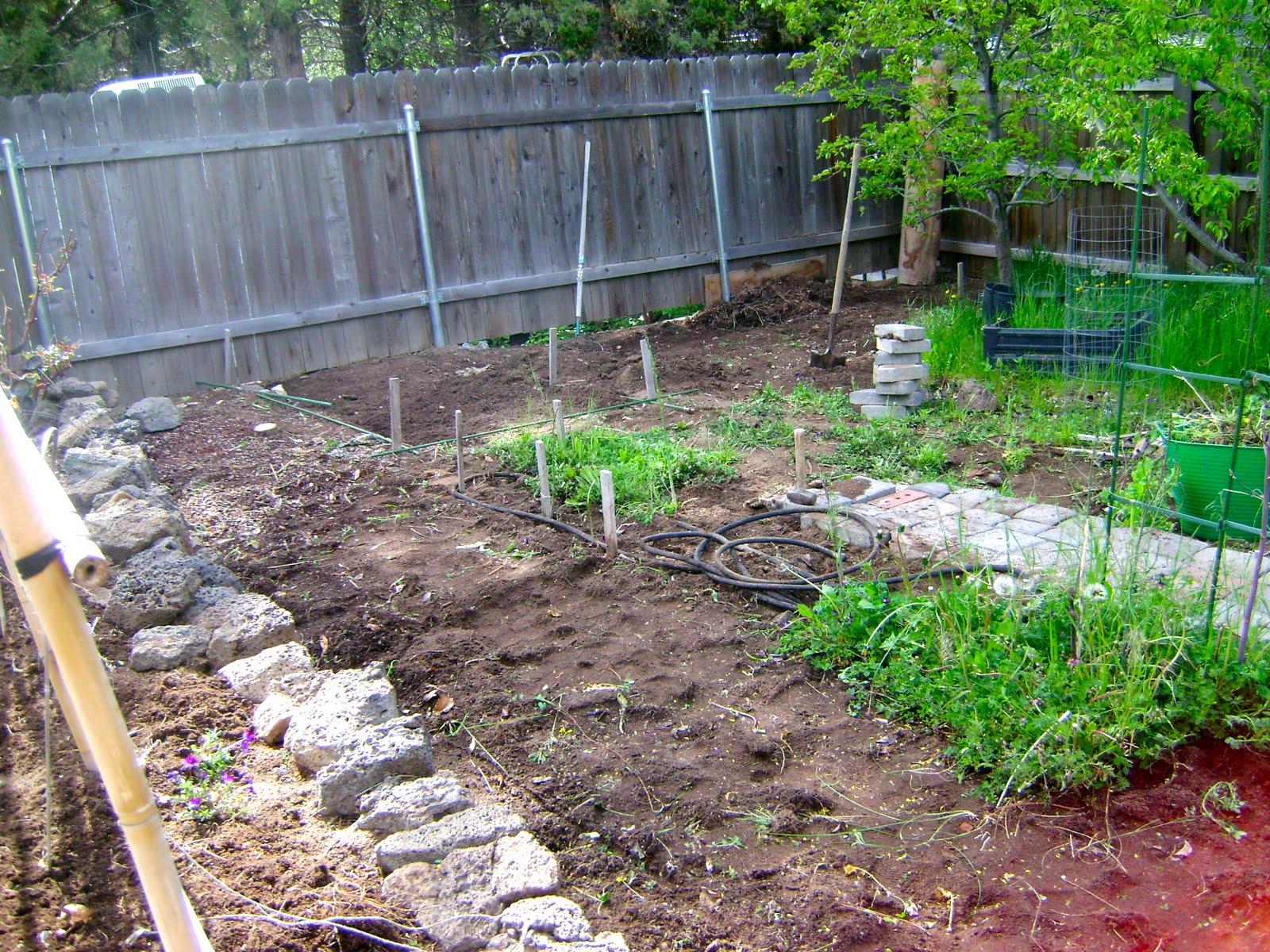
But even those of us who normally laugh at the weather whiners are dragging a bit this year. I had thought that, since the sweetheart and I spent part of yesterday putting together a new drip irrigation system for my new raised beds, the weather gods would be mollified. Rain often follows a good thorough soaking with ye olde sprinklers and hose. Probably it failed this time because today is PPP day.
What is PPP? It's the 36th annual Pole, Pedal, Paddle race, of course. This annual madness occurs each year around the third week in May, and in the week leading up to the race, the signs are everywhere around town: cars with canoes on top, cars with bikes on top, cars with kayaks, bikes and pods on top. People learning how to kayak on Mirror Pond, 3 days before the race. People renting skis and learning how to ski, 3 days before the race. This 'training' style is practiced by a good percentage of the 3000+ participants, many of whom, just once a year, arise from their couches and form teams with other couch potatoes, who jointly assemble rental skis, someone's rusty bike from the garage, a canoe and a grill (for the after party) and go mano a mano against other teams with names like 'Old Men in Skirts' .. 'Just Keeping Up With the Girls' (husbands) ... 'Shakey Buckets' ... 'The Geriatric and the Junior' .... 'Psycho Mega Hose Beast' .... and my favorite: 'Capitol Punishment' (a team of Republican and Democratic senators from the Oregon capitol, working in the best bipartisan tradition).
The interesting thing is that there is a whole other race, with competitors at the highest levels of athletic prowess. Through the years, Olympians past, present and future have come and raced, surprisingly often beaten by the locals -- among whom there are, admittedly, many former and past Olympians in various disciplines. The couch potatoes and the major dudes are all out there on the same course, though, thankfully, sorted into waves to avoid serious clashes of culture.
The race consists of 6 segments, and the top finishers complete it in well under 2 hours. The race begins on the groomed slopes of Mt. Bachelor ski area, 22 miles west of Bend, and finishes by the river, downtown.
1 Alpine skiing -- competitors must first sprint uphill, wearing helmets, boots and goggles, to grab and don their skis. After a mere 1.15 mile downhill run, the competitors switch to
2 Nordic skiing -- an 8 km course on groomed trails. Then there is a change of shoes and a hop onto the bikes for the
3 Cycling -- 21.7 mile, mostly downhill ride to downtown Bend. Off the bikes, another change of shoes and the
4 Run -- 5 miles, on roads, trails and gravel paths, finishing at the Deschutes River, where everyone hops off the bike and into their boat of choice for the
5 Paddle -- .8 km upstream, 1.2 downstream, then .4 back upstream to disembark and leap out for the final .5 km
6 Sprint.
Sounds like fun? You bet. And you have your choice of ways to have that fun. You can assemble a team of any kind and number -- business ..... family ....... beer-drinking buddies ........ hottie athletes ........ 3rd graders ..... favorite spouse or best friend ...... or you can do all of it solo!
After the race is over, the best part comes. Besides the sore muscles, I mean. And that is the After Parties. Traditionally, the less fit the team members, the bigger, louder and more beer-infused the after party and the grander the war stories. Believe me, they go on into the night. The serious athletes may party too, though I suspect many of them are already making plans for next year.
Judging by the thwock thwock sounds of helicopters over downtown outside my window right now, the first finishers -- the elite athletes and serious, serious soloists and pairs -- are close to the finish line. As for me, I have a heavy day planned of installing drip irrigation, taking down my laundry to dry inside, and transplanting things into the garden. And preparing to hear the sounds of partying until the wee hours tonight, spiced, undoubtedly, of tales of snow at the start line. It's always something.
Thoughts from my garden in the sagebrush ocean of Central Oregon
May 21, 2011
May 6, 2011
Oh the excitement!
During last year's tour I was out there, viewing other peoples' coops, looking for ideas for my own. This year I am one. Yikes. 24 hours out, I am frantically trying to get the place shipshape. The coldest April in decades has put a definite crimp in my spring gardening plans, from cleanup to seed-starting to planting out. I am weeks behind in everything.
My coop enhancement efforts have also been stymied. I had such plans, oh such glorious plans. New paths! Flower baskets at the window! Decorative art on the henhouse! But no. It's going to be just the usual chicken coop, warts and all. Hopefully people won't notice that Babe has bare sections from bad-ass dominant hen peckage. Or that Olive has lost her fluffy booty feathers from (I think) mites.
There have been photos of some really fancy Bend coops in the newspaper, on Sunset magazine's blog, and on tv. Some of these coops are nice enough for human housing. And here I've been thinking my coop is overly fancy for your average backyard chicken.
Still, it's fun to look back and see the beginnings. It started with research. Lots and lots of research.
Then came the peeps!
Now to find the perfect spot for a chicken coop....
Meanwhile, the girls were growing. Temporary day spa required. We settled on the poor white trash look.
Delivery day!
Painted and with girls installed.
Impromptu day spa added on the south side of the coop (look closely to see bird netting on top)
First egg -- on my birthday
Betty -- that's my girl!
Then came snow. Oops, that's it for the day spa.
Winter substitute. Back to the poor white trash look.
After allowing the girls to rampage in the garden during the winter, I finally had to call in the professionals. Well, one professional: my next-door neighbor, Tim, self-employed fine woodworker, artist, craftsman and all-around nice guy. Well, it was overkill, but he built me the day spa of my dreams last month.
Here's the late winter look of the empty corner.
Let the installation begin:
Love the clear roofing!
Ta da!
Thanks Tim. Now the girls must do their part: buff, primp and practice looking gorgeous.
Meanwhile, the new peeps are outside, though with a heat lamp for nighttime. It's still freezing most nights. In an effort to allow Babe to regrow her winter-pecked plumage, and allow the peeps to grow up within sight and sound of the Big Girls, I have divided the old run into 2 sections. So far, so good. I am pretty sure I have two roosters and only one wee hen .... but I'm hoping she will be enough to keep Babe company in smallness, once the three groups are finally merged.
That's it from here. 24 hours 'til CT-day.
May 1, 2011
May 1, 1971
It all started in March 1969. Boot 'n' Blister Club. Love at first sight. Really.
Here we are, caught smooching on one of our first BnB hikes together.
Here we are on the first Earth Day, April 22, 1970, at the Earth Fair in Eureka, California. Another stealth photo by a friend.
A year later, we married, rather reluctantly, to avert parental wrath at our 'sinful' living arrangements. We didn't particularly believe in marriage, but at the time felt it was worth it to make our lives less stressful. We knew we were going to be together forever, and didn't think it was necessary to have anyone else's permission or approval.
40 years later, we have both come around to a feeling of respect for marriage as an institution worthy of preserving and working hard at. I say that, while admitting that, if I were to get married today, I would have even fewer people present than we did in 1971. And that's saying something.
In retrospect, it seems like a nice hippie-type wedding. We had picked out a grassy meadow, complete with grazing sheep and huge oak trees, near the mouth of the Mattole River, on Cape Mendocino in northern California.
We asked a minister friend to do the job, and he showed up, unshaven and in casual clothes, in proper 'hippie minister' style. My parents and sister drove up from the San Francisco Bay Area. Don's family didn't come (I seem to remember his mum thought we were too young to be getting married) and the wedding guests numbered only 12, including the photographer and 3 small children.
Our friend Mike helped lay out the wedding feast on the tailgate of his 1961 Ford Falcon station wagon: a sheet cake from my parents' bakery, sandwiches, Creamline Dairy milk in the gallon glass jugs, and a case of champagne, of which I think less than 1 bottle was consumed. We weren't much for alcohol, and most people drank the milk.
Neither one of us knew much about 'proper' weddings, but we knew there was something about feeding each other cake.
Wedding guests were few but special.
Russ and his fiancee, Nadeine
Laurel and Lynn
Katie and Mara
I imagine the whole affair cost less than $100, including the minister's fee, the food, my dress, which my mother sewed and I embroidered with flowers on hem and sleeves, and the gasoline for all of us to drive out there. Even with inflation, I doubt many people get married so inexpensively, or so simply. I'm not saying getting married in a sheep pasture, under an old oak tree, is for everybody, but it suited us both perfectly.
40 years later, we're still together, still sweethearts, wondering how the time could have passed so quickly and still hanging out under trees and holding hands. It has been hard work at times. I always cry at weddings now, knowing the heartbreak and troubles ahead for everyone -- it's the human condition. Maybe if any of us knew what was ahead in life, we wouldn't be so willing to gamble on such things as Love! Marriage! But then, we didn't know, and so we did. So far it's still working out.
Thanks, sweetheart. I love you.
Here we are, caught smooching on one of our first BnB hikes together.
Here we are on the first Earth Day, April 22, 1970, at the Earth Fair in Eureka, California. Another stealth photo by a friend.
A year later, we married, rather reluctantly, to avert parental wrath at our 'sinful' living arrangements. We didn't particularly believe in marriage, but at the time felt it was worth it to make our lives less stressful. We knew we were going to be together forever, and didn't think it was necessary to have anyone else's permission or approval.
40 years later, we have both come around to a feeling of respect for marriage as an institution worthy of preserving and working hard at. I say that, while admitting that, if I were to get married today, I would have even fewer people present than we did in 1971. And that's saying something.
In retrospect, it seems like a nice hippie-type wedding. We had picked out a grassy meadow, complete with grazing sheep and huge oak trees, near the mouth of the Mattole River, on Cape Mendocino in northern California.
We asked a minister friend to do the job, and he showed up, unshaven and in casual clothes, in proper 'hippie minister' style. My parents and sister drove up from the San Francisco Bay Area. Don's family didn't come (I seem to remember his mum thought we were too young to be getting married) and the wedding guests numbered only 12, including the photographer and 3 small children.
Our friend Mike helped lay out the wedding feast on the tailgate of his 1961 Ford Falcon station wagon: a sheet cake from my parents' bakery, sandwiches, Creamline Dairy milk in the gallon glass jugs, and a case of champagne, of which I think less than 1 bottle was consumed. We weren't much for alcohol, and most people drank the milk.
Neither one of us knew much about 'proper' weddings, but we knew there was something about feeding each other cake.
Wedding guests were few but special.
Russ and his fiancee, Nadeine
Laurel and Lynn
Katie and Mara
I imagine the whole affair cost less than $100, including the minister's fee, the food, my dress, which my mother sewed and I embroidered with flowers on hem and sleeves, and the gasoline for all of us to drive out there. Even with inflation, I doubt many people get married so inexpensively, or so simply. I'm not saying getting married in a sheep pasture, under an old oak tree, is for everybody, but it suited us both perfectly.
40 years later, we're still together, still sweethearts, wondering how the time could have passed so quickly and still hanging out under trees and holding hands. It has been hard work at times. I always cry at weddings now, knowing the heartbreak and troubles ahead for everyone -- it's the human condition. Maybe if any of us knew what was ahead in life, we wouldn't be so willing to gamble on such things as Love! Marriage! But then, we didn't know, and so we did. So far it's still working out.
Thanks, sweetheart. I love you.
Apr 11, 2011
Oops
Chick fever. I would like to blame it on my friend Susan, who was 'forced' to get 2 new chicks last week when her new dog turned out to be a chicken killer,thus reducing her small flock to only two 3 year-old layers. I was already weakening, having walked less and less firmly by the brooder boxes full of peeping cuties each time I visited the feed store over the last few weeks. Enough chickens. I have enough chickens. Really.
But the fact is, I have chicken lust, unsatisfied by last year's initial plunge into chicken ranching. I can see right now that I will have to add April to my list of Danger Months for the year. During May and June I try to stay away from nurseries, with their alluring greenhouses full of annuals and perennials, calling, calling, calling to me: 'take us home. put us in your garden. mingle our colors on the deck. create a rainbow of containers. hurry, before it's too late. the season is short. you know you want to.' and so I succumb.
Now it seems I have to stay out of feed stores during late March and April. (But what if my girls need a bag of feed or some straw for their coop? No, just wait a while......)
OK, it's true. I have had my eye on various breeds to try, next time around, when these girls slow down on the laying. I don't imagine I will have the heart to do them in when their laying days are over, rather I plan to put them out to pasture, so to speak. But I will add a couple of new hens to the flock, probably next year, to keep the egg count up. We really love our fresh organic eggs.
So instead, I have managed, this past month, to walk by the peeping hordes of standard breed chicks, waiting for a good set of bantams! to be available. Two things have spurred me to action now .... well, along with the siren call of cuteness at the feed stores.
One -- my poor sole bantam, Babe, of the frizzled feathers, has become a ragged shadow of her former self over the winter. After all my research and care last year, I still underestimated the amount of space the girls would need, once they grew to full size. The run I had designed was just a bit snug, especially under cold, wet, wintry conditions and long hours of darkness. I also underestimated the power of 'pecking order' in a flock, and I have spent long hours, worrying and feeling sorry for Babe. She is the perfect peckee, different from the other hens in every way: smaller, different color, weird feathers, feathered feet .......
I have tried various things to mitigate the problem, but the fact is, she will always be at the bottom of the pecking order. Unless ......... she has some company in her smallness. So I decided to get her a pal, another bantam, with the idea that she would have someone to hang out with in the flock. Babe spends a lot of her time all by herself, a pariah, which saves her from constant pecking, of course, but I can see she is lonely.
Two, I have a new run, so there's a lot more room for all the girls to wander, peck and scratch. Room for a couple of new cuties to flit here and there and find safety from the big girls.
Thus the bantam chicks. Why three if I only want one pal for Babe? Other than chick lust, I am hoping for at least one hen amongst these little guys. Standard chicks are either sexed at the hatchery, or are sexable by color (in the case of sex-links), so when you buy chicks you are about 90-95% sure of getting all females. Last year I got 1 rooster out of 6 chicks -- bad luck, but not unheard-of. But bantams are too small to sex, I guess, so they come only 'straight run' from the hatchery. The chance of getting a hen is only 50/50, so I decided to up my odds by getting three.
These little peeps are already 2 weeks old -- getting a few feathers already on their wings -- but still tiny, compared to the newly-hatched standard chicks. I haven't named them yet, but can already see personalities developing. Again, I couldn't resist getting 3 different breeds, though this was more because these were what the feed store had, than choosing these exact kinds.
From left to right, we have a partridge cochin, a mottled cochin (I think -- the lady in the feed store was a bit vague), and a mille fleur belgian d-uccle (how's that for a mouthful). They should all be beautiful when they grow up, and I'm keeping my fingers crossed that I will get as many as 2 hens. Any roosters will have to be warranteed back to the feed store.
So the metal wash tub is back in the garage, the heat lamp suspended from the overhead ladder track, and the wee feeding and water dispensers are back in action. Peeping abounds. Cuteness rules. Aaaahhhhhhhhhh.
Mar 26, 2011
Instant Gratification, Small Recompense
It's still doing this most mornings:
Just a skiff of snow, the overnight temperatures right around freezing, or a few degrees below. As soon as the sun comes up, the snow melts and the spring day proceeds as usual: sunshine ..... clouds and a breeze ..... more sun ..... corn snow..... sun with corn snow ...... rain ...... dark clouds and gusty wind ....... sun ........ snowflakes ........ and so on. This is March -- the cruelest month (except for April, also cruel, and even sometimes May, and quite often June too) in Bend's spring season.
I don't know why anyone is surprised. It's the same very year. I guess it's just that by now, we are all pretty sick of grey and brown and nothing green for months and months and months. Deciduous trees don't leaf out until late April. Spring break, usually the 3rd week in March, is particularly evil. Traditionally -- and trust me, I've kept track -- it has the worst weather in the whole month. Why? Because innocent children all over the county (and their not-so-innocent but ever-so-deserving teachers and parents) have the week off for 'vacation'. So the weather gods, with whom I am normally on quite friendly terms, give a gleeful little giggle and send rain, snow, wind, hail, and many other kinds of wet, cold dreck to pummel Bendites.
Many head for warmer regions -- Hawaii is popular this time of year. My sweetheart heads to Majorca to ride his bike amid blooming almond orchards along the Mediterranean coast. However, for those of us who once again have plans to Get The Garden Going During Spring Break Week, we stay home, with hope -- foolish foolish hope -- in our hearts. And either break out the waterproof jackets and mud boots or dress in multiple layers of wool, including hats and gloves, and spend our days going inside when the rain/snow starts, then back outside when it stops -- over and over throughout the days.
I did get my raspberries pruned. And that is probably the only time I will feel smug until sometime in the fall. After March, I am always behind. I realize every gardener is always behind, because there are just too many things to do in the spring than there is spring to do it in. But still I feel guilty and rushed.
It wears on a person. It really does. BUT!!!!
My personal salvation often comes from the annual seed catalog-a-thon which takes place anywhere from mid-February (good Ned) to early April (bad Ned).
When I started gardening in 1971, I somehow hooked right into the seed catalog gardening lifestyle. Local nurseries had only minimal options and besides, I loved mail order. It seemed so .... pro ..... so 'in the know' -- something that I, as a newbie gardener, was desperate to achieve. The first catalogs arrived right after Christmas, and I spent months happily circling things, making lists, pruning them, adding things back on, and finally, writing checks, stuffing my precious orders into the mail and waiting. And waiting. And waiting.
Most of the places I ordered from were on the east coast, and it took a minimum of 2 weeks to get anything. Some companies were even slower.
In 30 -- no, 40 years (!!!) of gardening, all that has changed. Local nurseries have much better options for seeds of your average vegetables and flowers. But even now, if I want tomatoes that really will bear fruit in our short growing season, I rely on my faithful catalogs to get the seed. What has really changed is the whole catalog thing.
First one, then another, then a few more, seed companies began creating websites. At first, there were holdouts. Even some of the companies that had websites didn't offer online ordering. You could browse, you could admire, but you still had to fill out that printed order form and join the ranks of the waiters. But I am here to tell you, online ordering is the best thing to happen to mail order nuts addicts like me.
ONLINE ORDERING! Oh heavens. Forget 2 weeks. Most places now have an envelope full of seeds in the mail by the day after I order. Instant gratification -- especially good for people like me, who tend to procrastinate. Even if I don't order until the day after the Spring Equinox, I still have my tomato seeds in time to plant them in my greenhouse before the end of March. Sweet!
So while the weather does its thing, I sit at my desk during the worst stormy moments, and fondle my new seed packets. Better than gold doubloons in a pirate's chest.
Just a skiff of snow, the overnight temperatures right around freezing, or a few degrees below. As soon as the sun comes up, the snow melts and the spring day proceeds as usual: sunshine ..... clouds and a breeze ..... more sun ..... corn snow..... sun with corn snow ...... rain ...... dark clouds and gusty wind ....... sun ........ snowflakes ........ and so on. This is March -- the cruelest month (except for April, also cruel, and even sometimes May, and quite often June too) in Bend's spring season.
I don't know why anyone is surprised. It's the same very year. I guess it's just that by now, we are all pretty sick of grey and brown and nothing green for months and months and months. Deciduous trees don't leaf out until late April. Spring break, usually the 3rd week in March, is particularly evil. Traditionally -- and trust me, I've kept track -- it has the worst weather in the whole month. Why? Because innocent children all over the county (and their not-so-innocent but ever-so-deserving teachers and parents) have the week off for 'vacation'. So the weather gods, with whom I am normally on quite friendly terms, give a gleeful little giggle and send rain, snow, wind, hail, and many other kinds of wet, cold dreck to pummel Bendites.
Many head for warmer regions -- Hawaii is popular this time of year. My sweetheart heads to Majorca to ride his bike amid blooming almond orchards along the Mediterranean coast. However, for those of us who once again have plans to Get The Garden Going During Spring Break Week, we stay home, with hope -- foolish foolish hope -- in our hearts. And either break out the waterproof jackets and mud boots or dress in multiple layers of wool, including hats and gloves, and spend our days going inside when the rain/snow starts, then back outside when it stops -- over and over throughout the days.
I did get my raspberries pruned. And that is probably the only time I will feel smug until sometime in the fall. After March, I am always behind. I realize every gardener is always behind, because there are just too many things to do in the spring than there is spring to do it in. But still I feel guilty and rushed.
It wears on a person. It really does. BUT!!!!
My personal salvation often comes from the annual seed catalog-a-thon which takes place anywhere from mid-February (good Ned) to early April (bad Ned).
When I started gardening in 1971, I somehow hooked right into the seed catalog gardening lifestyle. Local nurseries had only minimal options and besides, I loved mail order. It seemed so .... pro ..... so 'in the know' -- something that I, as a newbie gardener, was desperate to achieve. The first catalogs arrived right after Christmas, and I spent months happily circling things, making lists, pruning them, adding things back on, and finally, writing checks, stuffing my precious orders into the mail and waiting. And waiting. And waiting.
Most of the places I ordered from were on the east coast, and it took a minimum of 2 weeks to get anything. Some companies were even slower.
In 30 -- no, 40 years (!!!) of gardening, all that has changed. Local nurseries have much better options for seeds of your average vegetables and flowers. But even now, if I want tomatoes that really will bear fruit in our short growing season, I rely on my faithful catalogs to get the seed. What has really changed is the whole catalog thing.
First one, then another, then a few more, seed companies began creating websites. At first, there were holdouts. Even some of the companies that had websites didn't offer online ordering. You could browse, you could admire, but you still had to fill out that printed order form and join the ranks of the waiters. But I am here to tell you, online ordering is the best thing to happen to mail order nuts addicts like me.
ONLINE ORDERING! Oh heavens. Forget 2 weeks. Most places now have an envelope full of seeds in the mail by the day after I order. Instant gratification -- especially good for people like me, who tend to procrastinate. Even if I don't order until the day after the Spring Equinox, I still have my tomato seeds in time to plant them in my greenhouse before the end of March. Sweet!
So while the weather does its thing, I sit at my desk during the worst stormy moments, and fondle my new seed packets. Better than gold doubloons in a pirate's chest.
Mar 20, 2011
Signs of the Season -- waxing philosophical
Since becoming a chicken rancher last spring, I have started observing seasonal cycles in greater detail than ever before in my life. Growing up in the San Francisco Bay Area of California, in a beautifully mild Mediterranean climate, I pretty much took the seasons, such as they were, for granted as a backdrop for kid activities.
When I began gardening in my early 20's, I was living in the rainy, foggy, perpetually damp redwood belt much farther north. My main focus was keeping the banana slugs out of the garden patch and coaxing reluctant tomatoes to bloom in the overcast summer months (definition of summer: fog instead of rain). I looked at the morning fog each 'summer' day and assessed the possibility of its melting off. It rarely did, but I did begin keeping an eye on the weather in a way I never had before.
Fast forward to my first garden in Bend a few years later. Suddenly there was snow in the winter and plenty of sunshine in the summer -- with frost possible any day, including summer. I became expert at checking the outside temperature before retiring to bed. My rule was, if it was 55 degrees or lower at 10:00 pm, with a clear sky, I covered things. Gradually I learned freezing was unlikely unless it was 45 degrees or lower. But still -- once those tender babies were in and growing well, I watched the weather like a hawk. And I acquired a good understanding of the word 'microclimates' as I learned the warm and cold spots of my south-facing, sloping yard.
In my 30's I became a serious student of astrology, and my knowledge of seasonal energies and plant growth gave me a quick and powerful grasp of the principles of the turning of the seasons from a more cosmic perspective. The symbolism of the various signs, planets, angles, and transits made perfect sense to me on a deep level. I reached out to the stars and looked at the night sky with new eyes.
As I turned to a more conscious co-creative gardening partnership with nature in my 40's, my perception of the seasonal energies deepened further. My 50's were an inward time in many ways, and a decade when I both integrated all that came before, and let go of a lot that was no longer useful, in my personal life and in my garden.
And then came chickens!
Suddenly 'daylength' meant a lot more than, "wow, cool, it's the Winter Solstice, the days will be getting longer from now on". Now the shortening days of late summer meant I needed to decide if I was going to install lights so my chickies wouldn't molt and stop laying in the short days of winter. Now I understood why ancient Celts celebrated the early February holy day of Imbolc (which morphed into the Christian Candlemas and the modern joke-holiday of Groundhog Day), with its 10 hours of daylight in early February, as a time when 'the back of old man winter is broken'. Plants, if protected behind glass or cold frame plastic, resume growth after a winter of stasis. And chickens, within a week of our reaching that magical number 10, began laying more regularly. Even with the lights in their henhouse, set at 13 hours of light, the girls had slowed down over the winter.
Back to plant world, see those cute little yellow crocus up at the top of the page? They are always the first to bloom in my garden, usually by mid-February or a little sooner. With our crazy out-of-sequence winter --- early fall snow, cold snowy November and December, 6 week balmy spell in January and early February, followed by two huge snow dumps and a third spell of temperatures hovering around 0 degrees F, this year they didn't bloom until early March (when the photo was taken). A few days later I took this photo:
Still, the clearest harbinger of equinoctial energies occurs every March in my kitchen. On March 18, it looks like this:
On March 19, we see this:
Overhead is the cause:
Due to the serendipitous placement of this skylight, just over the peak of the roof on the north side, we get a beam of light on the kitchen floor beneath it, 2 days before the spring equinox. Being close to 45 degrees north latitude, the sun reaches just high enough on that day each year to give us a taste of living inside a prehistoric stone circle. Floorhenge. The beam of light reappears near the fall equinox, and then disappears for the winter.
It's a pretty magical planet we live on, and it's good to have these reminders throughout the turning of the wheel of the seasons.
Feb 17, 2011
A study in contrasts
In a frenetic but obviously cosmically-aligned concantenation of events, I spent the first part of last weekend in periods of contrasting elements, arranged side-by-side. On Friday I presented a program for our local independent music teachers' group on 'internet resources for music teachers' which went as well as could be expected. Of course there was a technical glitch just before it started, which was resolved with a bit of sweat and desperate quick-thinking. The second technical glitch occurred in the middle of the talk, and went unsolved.
I am far from an expert on all things digital, cyber and electronic, but I had a good time putting a lot of information together and sharing it with my friends and colleagues. So, the first contrast was the information itself (high-tech) presented to a bunch of teachers of acoustic instruments, mostly piano (decidedly low-tech, even we could say, gravity-powered).
Then I threw some clothes into a suitcase and headed north for a music technology workshop, some 3+ hours away by car. My guide was Grace, my birthday GPS smartypants phone, decidedly high-tech
Poor Grace. Although I had put in my destination point (Cascade Locks, Oregon, on the Columbia River) there were 2 possible routes, and she chose the most obvious one, which goes over 2 mountain passes, while I planned to go the less obvious way, up and across the high desert plateaus to avoid traffic and potential snowy roads. I'm sure there's a way to specify a particular route but I don't know what it is. Thus Grace was quite determined to get me to the other road, once I got to the junction point.
One of the things I like about Grace is that she doesn't really 'argue' at times like this. But she is VERY determined and persistent in the face of what she is undoubtedly thinking is sheer human idiocy. Once I turned off onto my chosen route north, she continued for at least 20 minutes to find roads that would get me over to her chosen route. I tried to reassure her that I knew what I was doing, I had been this way before, I knew the territory (I have switched her voice over to 'Australian English' so of course I know the area better), but she was having none of it.
It was a relief to get beyond the last possible turnoff and get her resettled into MY route. Which, to give her credit, she did without a single complaint. After that I attempted without success to engage her in conversation to help while away the 2 hours of driving that followed. I think the next generation of GPS's should include a social interaction program.
Alas, when I reached Cascade Locks, I realized I had accidentally programmed in the wrong address so that Grace took me first to the local school (high tech failure due to low-tech human error), then a rather seedy motel with a name similar to the correct one (human error again), and finally, to my nice clean Best Western, which I spotted with my own low-tech human eyes, down the street from the parking lot.
We were running a bit late now, it was getting dark, and I still had to check in, eat dinner and get to my workshop by 6:30. Grace couldn't help me navigate to this, since the workshop was being held at a teaching center in the middle of the woods, and she really didn't know where it was. I had to follow good old-fashioned printed directions (low-tech) snail-mailed to me (low tech) by the instructor, by the fading light of a short mid-February day. First I had to cross this cool bridge (over the mighty Columbia River), right next to my motel:
This is the Bridge of the Gods, named after an older natural stone bridge (lowest of natural low tech) from 'Indian Legend', long since washed away (like the Indians.....). We made it, Grace and I, and the evening session of the workshop, an introduction to Sibelius, the coolest music-notation software ever, was wonderful. Very high-tech.
The setting, just a few hundred yards above Bear Creek outside Carson, Washington, not so much
Finally, the drive home Saturday afternoon. Back to low-tech, I crossed the bridge for the final time,
paying my toll of $1.00 to the friendliest tollbooth person I've ever met. When I had first crossed the bridge, she was so friendly and relaxed that I made bold to ask her, 'so, why IS it called Bridge of the Gods?' and she smiled, leaned out the tollboth window and told me all about it. 'Have a nice evening' was her parting comment.
Cascade Locks is a small place, and everyone I met there was super friendly. Then, before I headed for home, I had to check out the mural painted on the bridge support on the Oregon side:
It goes from left to right in chronological order, and I liked this side because it shows, from the top down, all the original inhabitants of the area: eagle, coyote, bear, mountain lion and (look closely) sasquatch. :)
Here's the main body of the mural. Not your average bridge support.
Here's a photo of the mountains in the background of the mural, just beyond the bridge. Apparently the rockslide that formed the original rock bridge calved off from these mountains.
The Columbia Gorge is an incredible place, and I am sorry not to have photos of the more spectacular portions. The most famous sections, with waterfalls and towering basalt walls overhanging the road, are west of here. The day was cloudy, and I speeded east with the aid of a powerful tailwind, with the storm gathering behind me.
i
Once out of the gorge, the road rises to a high plateau and for miles and miles, I drove by winter-greening hills of wheat, flaxseed and fruit orchards.
After that, I re-entered my familiar high desert, still up high. To the west, over the Cascades, the clouds continued to roll in,
getting closer and closer, until eventually the mountains themselves were engulfed. Here you can just see Mt. Hood, cloud banners streaming by, about to disappear.
At last, the road heads back down towards home ground, below 4000 ft of elevation. It's a long hill!
I arrived just after dark, as the storm winds hit Bend. Sunday was more low tech. Stay tuned. The story ain't over.
I am far from an expert on all things digital, cyber and electronic, but I had a good time putting a lot of information together and sharing it with my friends and colleagues. So, the first contrast was the information itself (high-tech) presented to a bunch of teachers of acoustic instruments, mostly piano (decidedly low-tech, even we could say, gravity-powered).
Then I threw some clothes into a suitcase and headed north for a music technology workshop, some 3+ hours away by car. My guide was Grace, my birthday GPS smartypants phone, decidedly high-tech
Poor Grace. Although I had put in my destination point (Cascade Locks, Oregon, on the Columbia River) there were 2 possible routes, and she chose the most obvious one, which goes over 2 mountain passes, while I planned to go the less obvious way, up and across the high desert plateaus to avoid traffic and potential snowy roads. I'm sure there's a way to specify a particular route but I don't know what it is. Thus Grace was quite determined to get me to the other road, once I got to the junction point.
One of the things I like about Grace is that she doesn't really 'argue' at times like this. But she is VERY determined and persistent in the face of what she is undoubtedly thinking is sheer human idiocy. Once I turned off onto my chosen route north, she continued for at least 20 minutes to find roads that would get me over to her chosen route. I tried to reassure her that I knew what I was doing, I had been this way before, I knew the territory (I have switched her voice over to 'Australian English' so of course I know the area better), but she was having none of it.
It was a relief to get beyond the last possible turnoff and get her resettled into MY route. Which, to give her credit, she did without a single complaint. After that I attempted without success to engage her in conversation to help while away the 2 hours of driving that followed. I think the next generation of GPS's should include a social interaction program.
Alas, when I reached Cascade Locks, I realized I had accidentally programmed in the wrong address so that Grace took me first to the local school (high tech failure due to low-tech human error), then a rather seedy motel with a name similar to the correct one (human error again), and finally, to my nice clean Best Western, which I spotted with my own low-tech human eyes, down the street from the parking lot.
We were running a bit late now, it was getting dark, and I still had to check in, eat dinner and get to my workshop by 6:30. Grace couldn't help me navigate to this, since the workshop was being held at a teaching center in the middle of the woods, and she really didn't know where it was. I had to follow good old-fashioned printed directions (low-tech) snail-mailed to me (low tech) by the instructor, by the fading light of a short mid-February day. First I had to cross this cool bridge (over the mighty Columbia River), right next to my motel:
This is the Bridge of the Gods, named after an older natural stone bridge (lowest of natural low tech) from 'Indian Legend', long since washed away (like the Indians.....). We made it, Grace and I, and the evening session of the workshop, an introduction to Sibelius, the coolest music-notation software ever, was wonderful. Very high-tech.
The setting, just a few hundred yards above Bear Creek outside Carson, Washington, not so much
Finally, the drive home Saturday afternoon. Back to low-tech, I crossed the bridge for the final time,
paying my toll of $1.00 to the friendliest tollbooth person I've ever met. When I had first crossed the bridge, she was so friendly and relaxed that I made bold to ask her, 'so, why IS it called Bridge of the Gods?' and she smiled, leaned out the tollboth window and told me all about it. 'Have a nice evening' was her parting comment.
Cascade Locks is a small place, and everyone I met there was super friendly. Then, before I headed for home, I had to check out the mural painted on the bridge support on the Oregon side:
It goes from left to right in chronological order, and I liked this side because it shows, from the top down, all the original inhabitants of the area: eagle, coyote, bear, mountain lion and (look closely) sasquatch. :)
Here's the main body of the mural. Not your average bridge support.
Here's a photo of the mountains in the background of the mural, just beyond the bridge. Apparently the rockslide that formed the original rock bridge calved off from these mountains.
The Columbia Gorge is an incredible place, and I am sorry not to have photos of the more spectacular portions. The most famous sections, with waterfalls and towering basalt walls overhanging the road, are west of here. The day was cloudy, and I speeded east with the aid of a powerful tailwind, with the storm gathering behind me.
i
Once out of the gorge, the road rises to a high plateau and for miles and miles, I drove by winter-greening hills of wheat, flaxseed and fruit orchards.
After that, I re-entered my familiar high desert, still up high. To the west, over the Cascades, the clouds continued to roll in,
getting closer and closer, until eventually the mountains themselves were engulfed. Here you can just see Mt. Hood, cloud banners streaming by, about to disappear.
At last, the road heads back down towards home ground, below 4000 ft of elevation. It's a long hill!
I arrived just after dark, as the storm winds hit Bend. Sunday was more low tech. Stay tuned. The story ain't over.
Subscribe to:
Posts (Atom)